
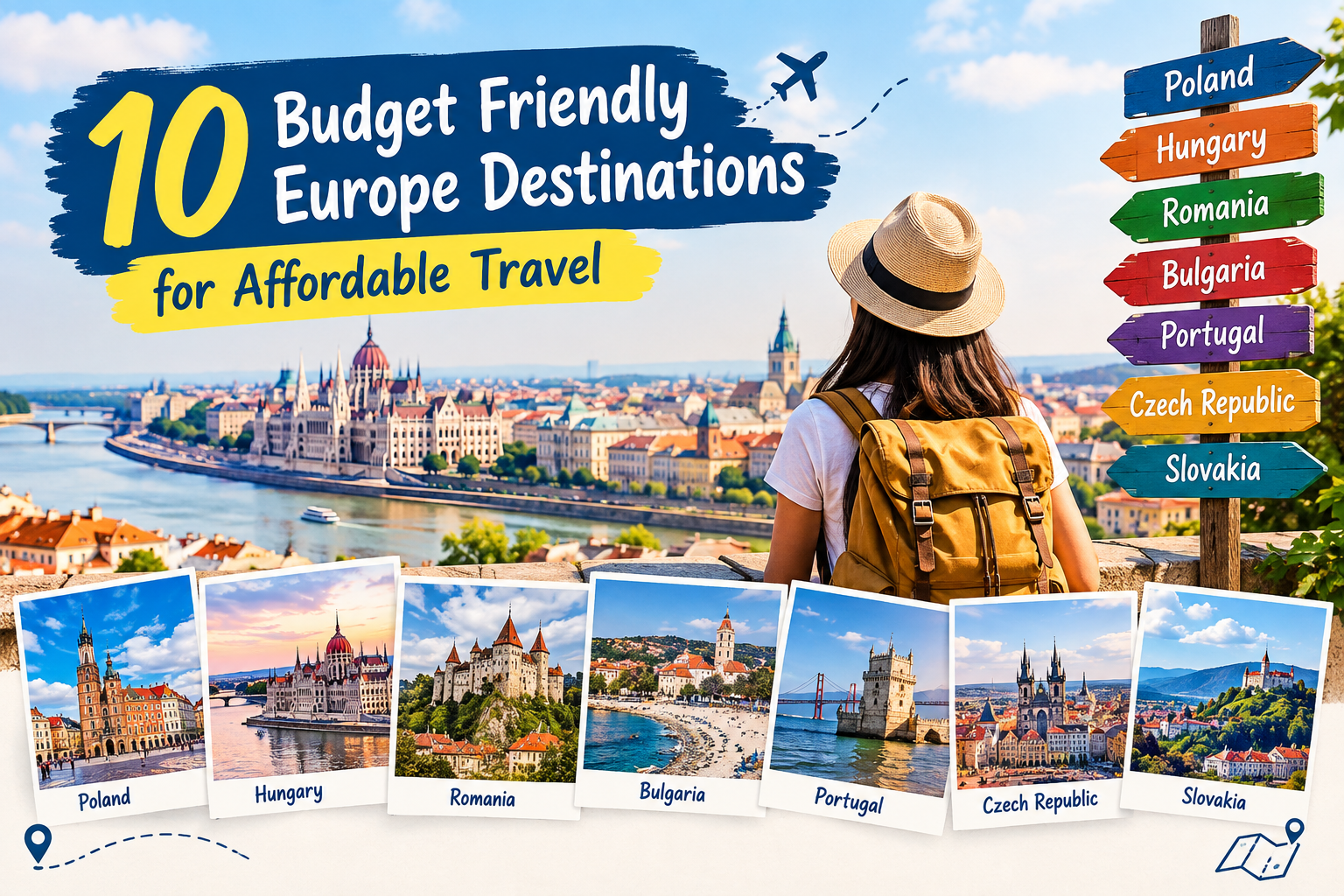
Let's be honest: Europe has a reputation for emptying your wallet. But where you go, when you go and where you stay make a bigger difference than most people expect. For Indian travellers, Central and Eastern Europe in particular have places where meals, hotels and local transport cost far less than in cities like Paris or Zurich.
In this guide, we look at some of the best budget friendly europe destinations,along with practical travel tips, budgeting advice and what to know about visas.
If you're looking for relatively affordable European destinations, consider Hungary, Poland, Romania, Bulgaria, Czechia, Slovakia, Portugal, Greece, Croatia and Latvia.
|
Destination |
Best For |
Budget Focus |
|
Hungary |
Budapest & culture |
Affordable city travel |
|
Poland |
History & food |
Budget accommodation |
|
Romania |
Castles & nature |
Lower daily expenses |
|
Bulgaria |
Beaches & mountains |
Affordable stays |
|
Czech Republic |
Prague |
Public transport |
|
Slovakia |
Mountains & city breaks |
Short trips |
|
Portugal |
Beaches & cities |
Shoulder-season travel |
|
Greece |
History & islands |
Off-season travel |
|
Croatia |
Coast & old towns |
Shoulder season |
|
Latvia |
Riga & Baltic travel |
Compact city breaks |
Keep in mind that your actual spending will depend on flights, season, where you stay and how you like to travel.
Hungary, and Budapest above all, is a great pick if you want culture, grand architecture and thermal baths without paying the prices of some Western European capitals. It's an easy city to enjoy on a modest budget.
Why visit: Budapest offers impressive architecture, thermal baths, river views and a lively food scene without the prices found in many Western European capitals.
Best for: Couples, first-time visitors and city breaks.
Places to visit: Budapest, Lake Balaton and Eger.
Budget tip: Stay outside the most touristy parts of central Budapest and use public transport. A budget traveller can plan around ₹6,000–₹8,500 per person per day, excluding international flights.
Ideal trip length: 3–4 days
Poland blends historic old towns, hearty local food and striking architecture. Kraków, Warsaw and Gdańsk each have plenty to see, and eating at local restaurants and using public transport keeps daily spending in check.
Why visit: Kraków, Warsaw and Gdańsk offer different experiences, from medieval architecture and museums to local food and vibrant city life.
Best for: History, families and first-time travellers.
Places to visit: Kraków, Warsaw, Gdańsk and Wrocław.
Budget tip: Use trains and public transport instead of taxis, and choose local restaurants or casual eateries for meals. A practical budget is around ₹5,500–₹8,000 per person per day, excluding international flights.
Ideal trip length: 4–5 days
If castles, mountains and medieval towns sound like your kind of trip, Romania deserves a look. You can fit Bucharest, Brașov and Transylvania into one itinerary without it getting too expensive.
Why visit: Bucharest provides a city experience, while Brașov and Transylvania offer historic architecture, mountain scenery and famous castles.
Best for: Nature, history and anyone who prefers fewer crowds.
Places to visit: Bucharest, Brașov, Sibiu and Bran Castle.
Budget tip: Travel by train or bus between major destinations and consider guesthouses outside the busiest tourist areas. Budget travellers can plan for approximately ₹5,000–₹7,500 per person per day, excluding international flights.
Ideal trip length: 4–5 days
Bulgaria packs in historic cities, mountains and beaches. Sofia and Plovdiv are good for culture, while the Black Sea coast is a natural fit for a summer holiday.
Why visit: Sofia and Plovdiv are ideal for culture and history, while destinations along the Black Sea offer beaches and summer activities.
Best for: Families, beaches and mountain holidays.
Places to visit: Sofia, Plovdiv, Bansko, Varna and Nessebar.
Budget tip: Consider local accommodation and public transport, and avoid peak-season beach prices where possible. A reasonable budget is around ₹4,500–₹7,000 per person per day, excluding international flights.
Ideal trip length: 3–4 days
Prague is one of the most recognisable historic cities in Europe. The centre is compact, public transport is easy to use, and there's no shortage of things to see, which makes it a practical choice for a short budget trip in Europe.
Best for: Architecture, couples and history lovers.
Slovakia suits travellers who like mountains and smaller cities. Bratislava works well for a quick visit, and the High Tatras are the place to go for hiking and other outdoor activities.
Best for: Nature lovers, backpackers and short trips.
Portugal gives you a taste of Western Europe, with historic cities, lovely beaches and really good food. Lisbon, Porto and Sintra are the usual favourites, and visiting outside peak summer can bring accommodation costs down noticeably.
Best for: Couples, food lovers and beach holidays.
A Greek holiday doesn't have to mean pricey island resorts. Athens and Thessaloniki are rich in history and culture, and avoiding the busiest summer months makes accommodation far easier on the budget.
Best for: History, beaches and couples.
Croatia is famous for its Adriatic coastline and charming old towns. Zagreb, Split and Dubrovnik each offer a different experience, and travelling in the shoulder season usually gives you better value than the peak summer rush.
Best for: Beaches, couples and coastal holidays.
If the Baltic region interests you, Latvia is worth a look. Riga's Old Town, its Art Nouveau buildings and its compact centre make it ideal for a short city break.
Best for: Solo travellers, architecture and Baltic travel.
The Europe travel cost from India depends on several things: airfare, destination, accommodation, food, local transport, visa and travel dates.
A practical 7-day budget can look like this:
|
Expense |
Approximate Cost Per Person |
|
Return flight from India |
₹50,000–₹75,000 |
|
Schengen visa + service charges |
₹9,000–₹12,000 |
|
Accommodation |
₹20,000–₹40,000 |
|
Food |
₹15,000–₹25,000 |
|
Local & intercity transport |
₹8,000–₹18,000 |
|
Sightseeing |
₹8,000–₹15,000 |
|
Estimated total |
₹1.2 lakh–₹1.8 lakh |
A budget-oriented seven-day trip can vary a lot, so it's better to compare the total cost of the trip rather than focusing only on hotel prices.
Planning an affordable Europe trip from India takes more than hunting for a cheap hotel. Here's what helps.
Book flights carefully. Compare different travel dates and departure airports before you lock in your itinerary.
Travel during shoulder season. April–May and September–October often strike a good balance between weather, crowds and prices, though it depends on the destination.
Use public transport. Metros, buses and trains can cut your daily transport costs significantly.
Choose practical accommodation. Staying a little outside the main tourist areas often means lower rates, and the attractions are usually still within easy reach.
Don't cram in too many countries. A slower trip saves on transport and lets you actually enjoy each place. For a 7-day trip, choosing one or two countries is often more practical than trying to cover four or five. Fewer intercity journeys can reduce transport costs and leave you with more time to explore.
Good budget Europe travel comes from looking at the whole holiday rather than any single expense. Some ways to save:
Book flights early
Compare accommodation options
Eat at local restaurants
Pick up some meals from supermarkets
Make use of free attractions
Rely on public transportation
Travel outside peak season
Avoid unnecessary intercity flights
A Europe trip under ₹1 lakh can work for some travellers, particularly with a short itinerary, budget accommodation and a good airfare. But flights, visa costs, travel dates and your choice of destination can quickly push the final figure up.
That's why it makes sense to work out your full Europe travel cost from India before you book anything.
All 10 destinations covered in this guide are currently part of the Schengen Area. Indian travellers visiting these countries for tourism generally need a short-stay Schengen visa, subject to the applicable visa requirements.
A Schengen short-stay visa generally permits stays of up to 90 days within any 180-day period, subject to the conditions of the visa issued. This is commonly called the 90/180-day rule. The calculation considers your stays across the Schengen Area rather than treating each country separately.
You may be asked for documents such as:
Passport
Visa application form
Accommodation details
Travel itinerary
Financial proof
Travel insurance
Flight reservation
Supporting documents
The standard Schengen visa fee for adults is €90. An additional service fee may apply when you submit your application through an external visa service centre. The normal processing time is 15 days, although it may be extended to up to 45 days in certain cases.
1. What are the most budget friendly Europe destinations?
Hungary, Poland, Romania, Bulgaria, Czech Republic and Slovakia are popular choices if you're planning an affordable European holiday.
2. How much does a Europe trip cost from India?
It depends on your flights, accommodation, food, transport, visa costs and itinerary. Even a seven-day trip can differ quite a bit based on when you travel and where you go.
3. How can I plan a Europe trip on a budget?
Compare flights, travel in the shoulder season, pick affordable places to stay, use public transport and don't try to cover too many destinations in one go.
4. Can I plan an affordable Europe trip from India under ₹1 lakh?
It's possible with careful planning, but treat ₹1 lakh as a target rather than a guaranteed total.
Understanding the right visa category, required documents and application process can make your planning much easier. Golden Future can help you understand the European visa process and prepare your application based on your travel plans.
Explore European destinations or speak with Europe visa King team to get started.