
Studying abroad is a dream for many students, and Europe has become one of the most popular destinations to turn that dream into reality. A masters degree in Europe offers much more than an internationally recognised qualification—it provides access to quality education, practical learning, and global career opportunities. From engineering and business to data science and healthcare, students can choose from thousands of English taught courses offered by leading European universities.
For Indian students, Europe is especially attractive because of its affordable tuition fees, scholarship opportunities, and excellent work prospects after graduation. However, getting admission requires proper planning, from choosing the right university to preparing your SOP, meeting the application process, and understanding visa requirements.
This guide will help you understand every important step so you can confidently study masters in Europe and make informed decisions for your future.
The choice to pursue a masters degree in Europe will prove to be a wise decision for any individual that is seeking an internationally recognized education at affordable prices.
The main advantages that come with it include:
Top-ranked universities: Europe hosts some highly recognized universities that provide industry-oriented education and research experience.
Affordable education: Many public universities in Europe have low tuition fee rates for quality education.
Wide course selection: There are hundreds of masters programs in Europe across fields like AI, Business, Engineering, Finance, and Healthcare.
Career opportunities: Most European countries allow international students to work part-time during their studies, subject to country-specific regulations.
International exposure: Interaction with students from diverse backgrounds will help develop global connections.
If you're looking for affordable education or to improve your career prospects in the future, then the Europe master's degree will be ideal for your future success.
Many students compare Europe with destinations like the USA, Canada, and Australia before making a final decision. Europe stands out because of:
Lower tuition fees in many countries
Affordable living costs
1–2 year master's programmes
Hundreds of English-taught courses
Excellent scholarship opportunities
Access to 27+ Schengen countries
Strong post-study work opportunities in several European countries
Globally recognised universities
It is necessary to be aware of the basic criteria for admission in a Europe master's program before applying for any university. Every university may have different criteria but they are usually similar.
Generally, the following are needed:
A recognized Bachelor's Degree in any related field.
Academic Transcripts as per the University's requirement.
SOP detailing your academic and career aspirations.
Proof of English language competence in the form of IELTS, TOEFL, or any other acceptable alternatives.
A valid passport for application procedures.
Financial proofs using either personal funds or education loan as necessary.
Getting the above documents ready will save time and increase your chances of being admitted.
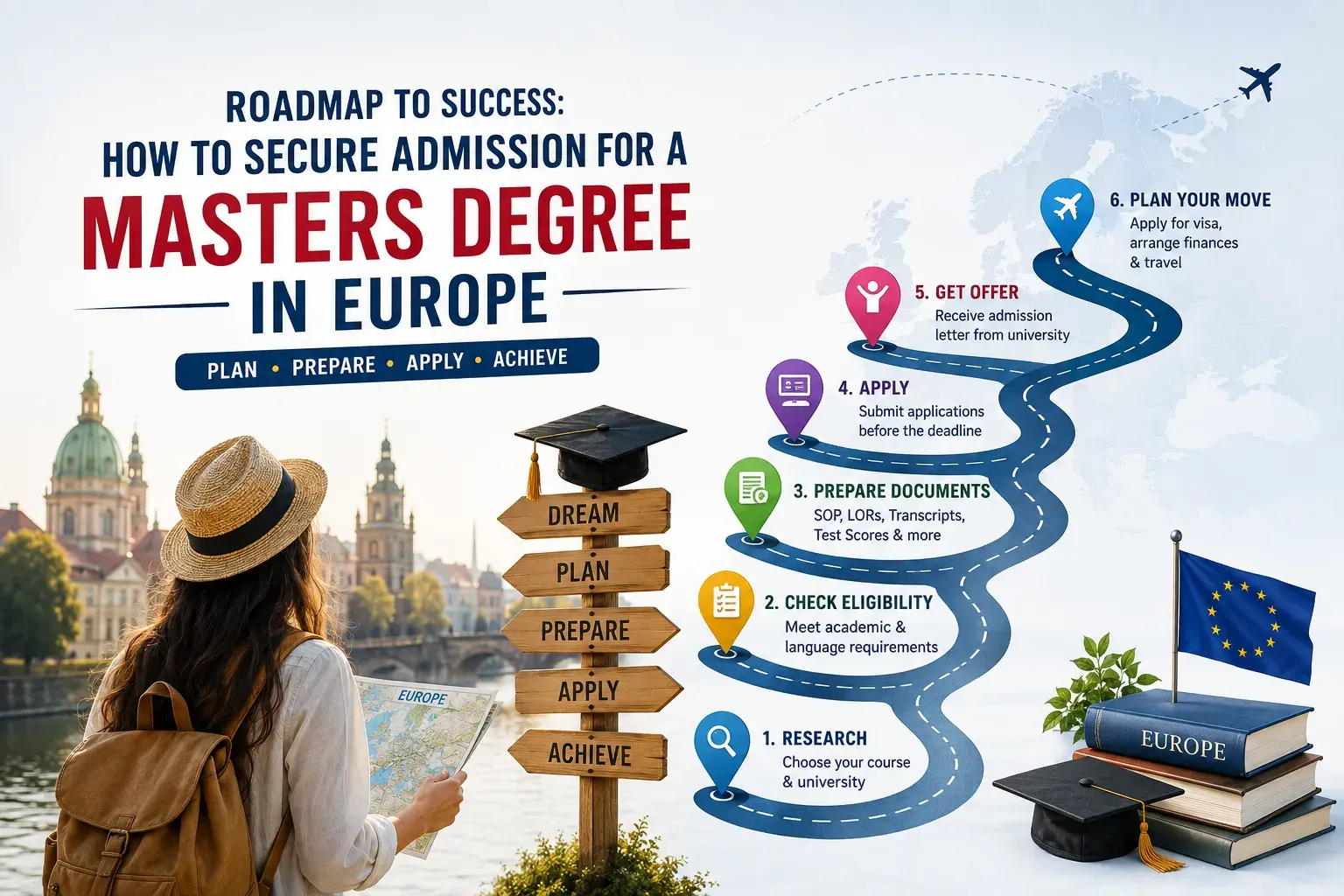
The process of admission in Europe to pursue a master's degree becomes easy if there is a proper procedure in place.
Choose a master's degree course and select countries with high-quality education, low tuition fees, and good employment opportunities in the future.
Compare universities in Europe for masters based on rankings, curriculum, internships, and admission requirements.
Prepare all your documents including academic transcripts, passport, SOP, English language test scores and more.
Apply via the university portal ahead of your preferred admission cycle. Early application will also increase your chances of receiving a scholarship.
Once you receive your admission letter, confirm your seat, arrange your finances, and begin the Europe student visa process by preparing all the required documents.
Not sure which university fits your profile? Our counsellors can help you shortlist the best options.
With proper planning and timely applications, you will be able to make a successful transition towards a rewarding master’s program abroad. Moving on, in the next segment we will cover the best countries to do master’s in Europe, universities to apply to, costs of studying there and affordable study programs.
Most European universities offer multiple admission intakes.
|
Intake |
Application Period |
Best For |
|
September (Fall) |
December–May |
Most courses available |
|
January |
July–October |
Limited programmes |
|
February (where applicable) |
August–November |
Available at selected universities |
One of the biggest advantages of pursuing a masters in Europe is the wide choice of destinations. Each country has its own strengths, so your decision should depend on your preferred course, career goals, and budget.
|
Country |
Best Known For |
Average Tuition Fees (Per Year) |
|
Germany |
Engineering, AI, IT |
€0 at Many Public Universities |
|
France |
Business, Fashion, Hospitality |
€3,000–€10,000 |
|
Italy |
Architecture, Design, Engineering |
€2,000–€6,000 |
|
Spain |
MBA, Tourism, Marketing |
€2,500–€8,000 |
|
Ireland |
Data Science, Finance, IT |
€10,000–€25,000 |
These are among the best countries for masters in Europe, offering globally recognised degrees, modern campuses, and excellent career opportunities. Many universities also provide dedicated support for masters in Europe for Indian students and other international applicants.
There are a few great institutions in Europe that provide new ways of teaching and research-based learning. If you plan on applying for universities in Europe for masters, check out these popular universities:
Technical University of Munich (Germany)
Sorbonne University (France)
University of Bologna (Italy)
Delft University of Technology (Netherlands)
Trinity College Dublin (Ireland)
These universities offer a wide range of masters programs in Europe, including many English taught courses, making it easier for international students to study without learning a new language.
The cost of masters in Europe depends on the country, university, and your lifestyle. Besides tuition fees, you should also plan for accommodation and daily expenses.
|
Expense |
Estimated Monthly Cost |
|
Student Accommodation |
€300–€900 |
|
Food & Groceries |
€200–€350 |
|
Transportation |
€30–€100 |
|
Miscellaneous |
€100–€250 |
Planning your finances in advance, exploring scholarships, and considering an education loan can help you manage both tuition fees and living expenses comfortably.
Many students believe studying abroad is expensive, but several countries offer affordable masters in Europe through government-funded and public universities.
Some of the most budget-friendly destinations include:
Germany – Low or no tuition fees at many public universities.
Italy – Affordable education with regional scholarships.
France – Government-supported universities with reasonable tuition.
Hungary – Excellent value for international students.
Choosing an affordable masters degree in Europe makes it possible to get a quality education and keep costs in check.
Financial support is one of the biggest reasons students choose to study in Europe. Various governments and universities offer scholarships in Europe to reduce the financial burden on international students.
Some of the most popular options include:
Erasmus Mundus Scholarship
DAAD Scholarship (Germany)
Eiffel Excellence Scholarship (France)
Stipendium Hungaricum (Hungary)
Italian Government Scholarships
Most scholarships are merit-based and highly competitive, so students should apply well before deadlines.
Need help finding scholarship opportunities? Contact Golden Future for personalised guidance.
Many universities may waive IELTS if applicants meet alternative English language requirements such as a Medium of Instruction certificate, accepted English proficiency tests, or a university interview.
Common alternative options include:
Medium of Instruction (MOI) Certificate
TOEFL, PTE, or Duolingo scores
University English interview
Always check the language requirements of your chosen university before applying.
After receiving your admission letter, the next step is applying for a Europe student visa. Although the process varies by country, you'll generally need:
Valid passport
University admission letter
Financial proof
Health insurance
Completed visa application form
Proof of accommodation
Careful preparation of documents according to the visa requirements of the country will lead to a successful visa application process.
Completing a master degree in Europe for international students can open doors to rewarding careers across various industries. Many countries offer a post study work visa, allowing graduates to gain valuable international work experience.
High-demand sectors include:
Artificial Intelligence
Information Technology
Engineering
Finance
Healthcare
Data Science
With the right skills and qualifications, depending on local labour market conditions, visa regulations, language proficiency, and individual qualifications.
Here are some mistakes to avoid during the admission process:
Applying close to deadlines.
Writing a generic SOP.
Ignoring scholarship deadlines.
Choosing a university based only on rankings.
Underestimating tuition fees and living expenses.
Submitting incomplete documents.
Starting your preparation early and seeking expert guidance can make your admission journey much smoother.
Germany, France, Ireland, Italy, and the Netherlands are among the top choices, depending on your course, budget, and career goals.
Tuition fees generally range from €0 to €25,000 per year, while monthly living expenses vary between €700 and €1,500 depending on the country.
Yes. Many universities accept alternatives such as an MOI certificate, TOEFL, PTE, Duolingo, or an English interview.
Yes. Many government-funded and university-specific scholarships in Europe are available for deserving international students.
Yes. Most European countries allow international students to work part-time while pursuing their studies, subject to local regulations.
The September/Fall intake is the most popular, although many universities also offer January or Spring intakes.
Most programs take 1–2 years, depending on the country and specialization.
A masters degree in Europe is an excellent choice for students seeking quality education, international exposure, and strong career prospects. With affordable study options, globally recognised universities, and a wide range of scholarships, Europe offers something for every aspiring student.
The key to a successful admission journey is choosing the right university, preparing your documents carefully, and applying on time. If you're planning to study masters in Europe, expert guidance can make the process simpler and increase your chances of success.
At Golden Future, we help students at every stage—from university selection and application support to visa assistance and pre-departure guidance. Take the first step today and move closer to achieving your dream of studying in Europe.